
HISTORY, CIVILIZATION AND CULTURE | TAUQEER ZAFAR
For most of human history, people did not live in cities. They moved with the seasons, followed animals, gathered plants, searched for water and adapted themselves to changing environments. Their communities were generally small and closely connected to the resources immediately around them. There were no great streets, administrative centres or monumental temples. Then, gradually, something changed. People began staying in one place, building permanent homes, cultivating land and storing food. Settlements that had once been temporary became communities capable of surviving across generations. Eventually, some of those communities grew into the first cities.
This transformation did not happen suddenly. Agriculture, population growth, food surplus, craft specialisation, trade, religious institutions and political authority developed at different times and in different combinations. The city emerged when these developments began to operate together at a scale that required new forms of organisation. It was therefore not simply a larger village. It was a new way of arranging human life.
Before the City
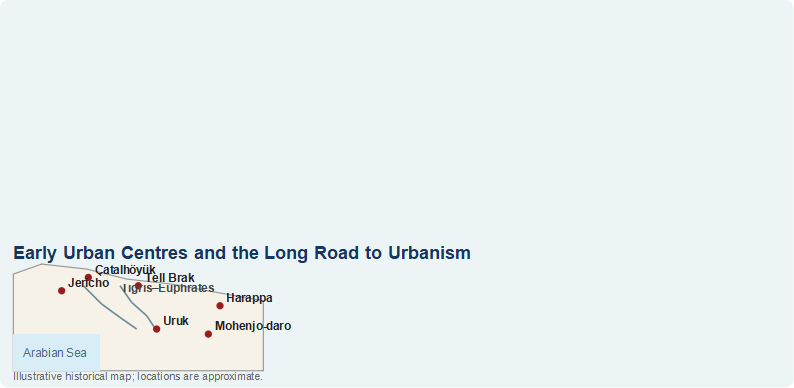
The foundations of urban life were laid thousands of years before the first recognisable cities. In several parts of Southwest Asia, communities increasingly settled in places with reliable water, fertile land and access to natural resources. Jericho is an early example. By the Neolithic period, it had developed into a substantial permanent settlement, with houses and collective constructions that demonstrate an ability to organise labour on a significant scale.
Yet Jericho was not a city in the later sense. This distinction is important. Permanent settlement did not automatically produce urban civilisation. A village could remain relatively small, with most economic and social activity centred on households and kinship. Urbanism required a greater concentration of population and increasingly specialised institutions.
The real transformation began when communities became capable of producing and managing resources on a scale larger than the individual household.
Agriculture and the Surplus
Where Does a City Begin?
Mesopotamia and the Urban Revolution
When Memory Was No Longer Enough
Institutions and the New Structure of Power
Cities Needed the Countryside
Not One Birthplace of Urbanism